Battery is the new form of "fuel" for electric vehicles, you never need to go to gasoline station to refuel your outboard anymore. You only need to recharge your batteries at home or docking place.
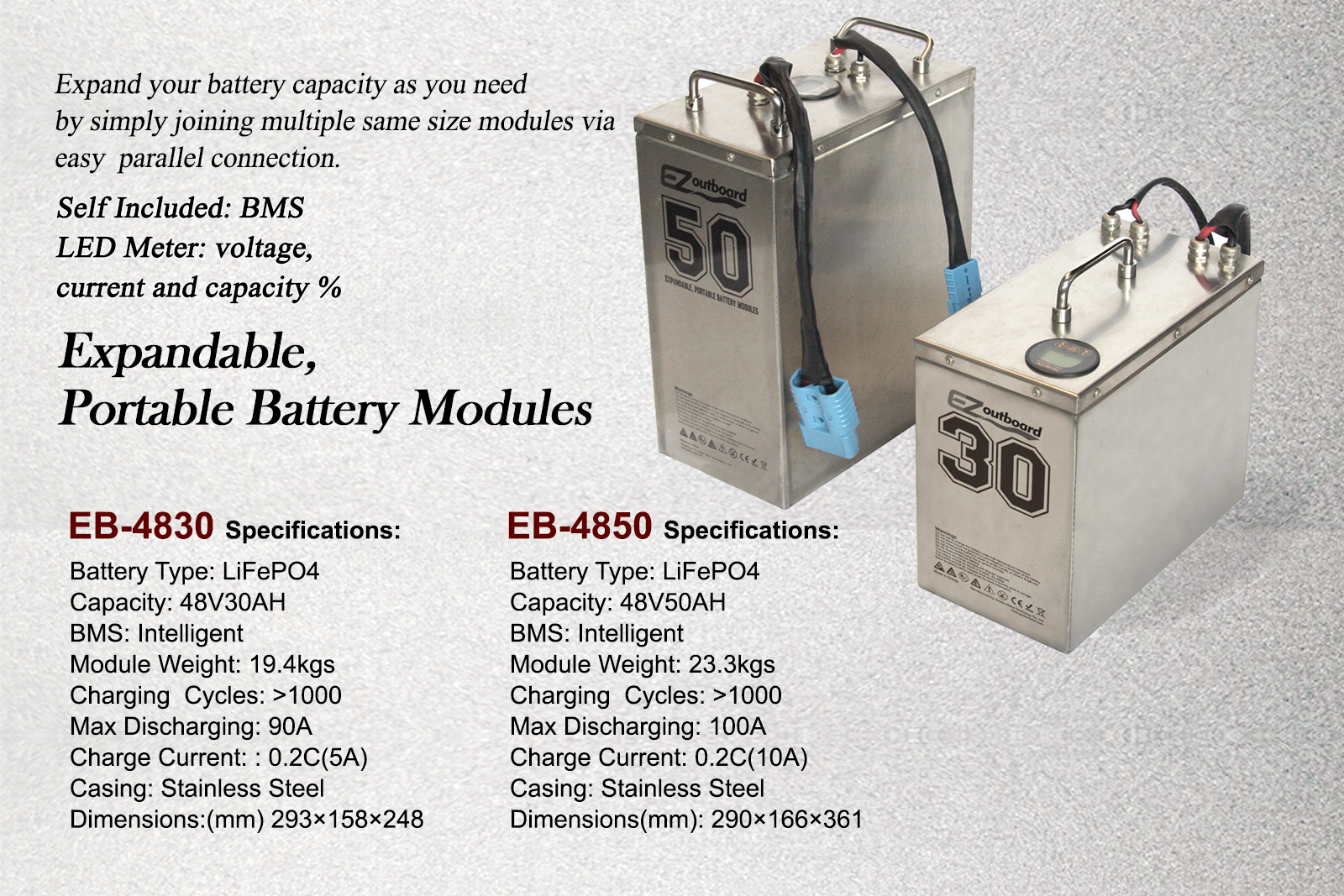
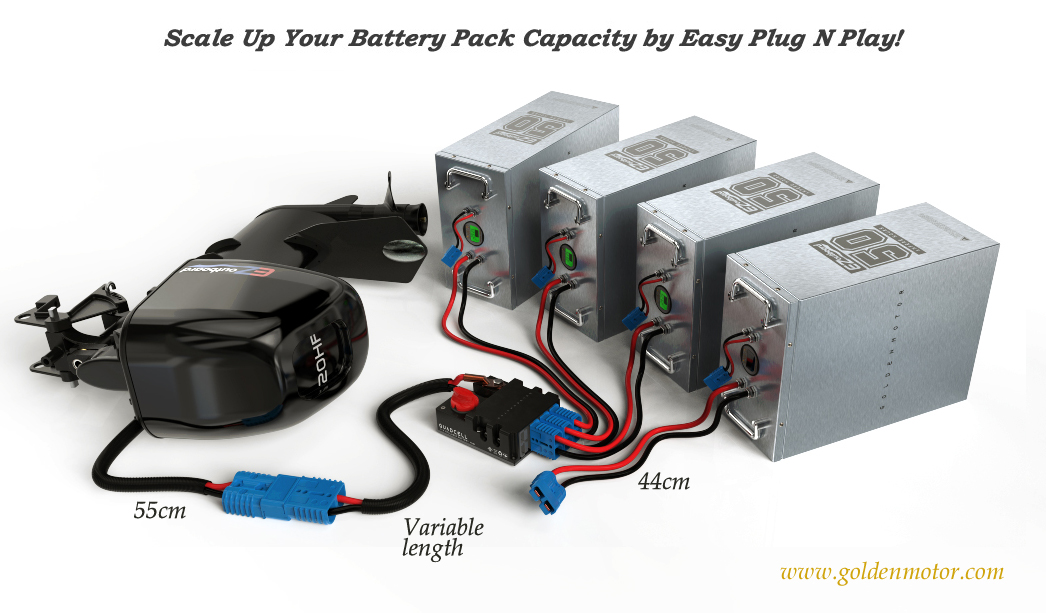
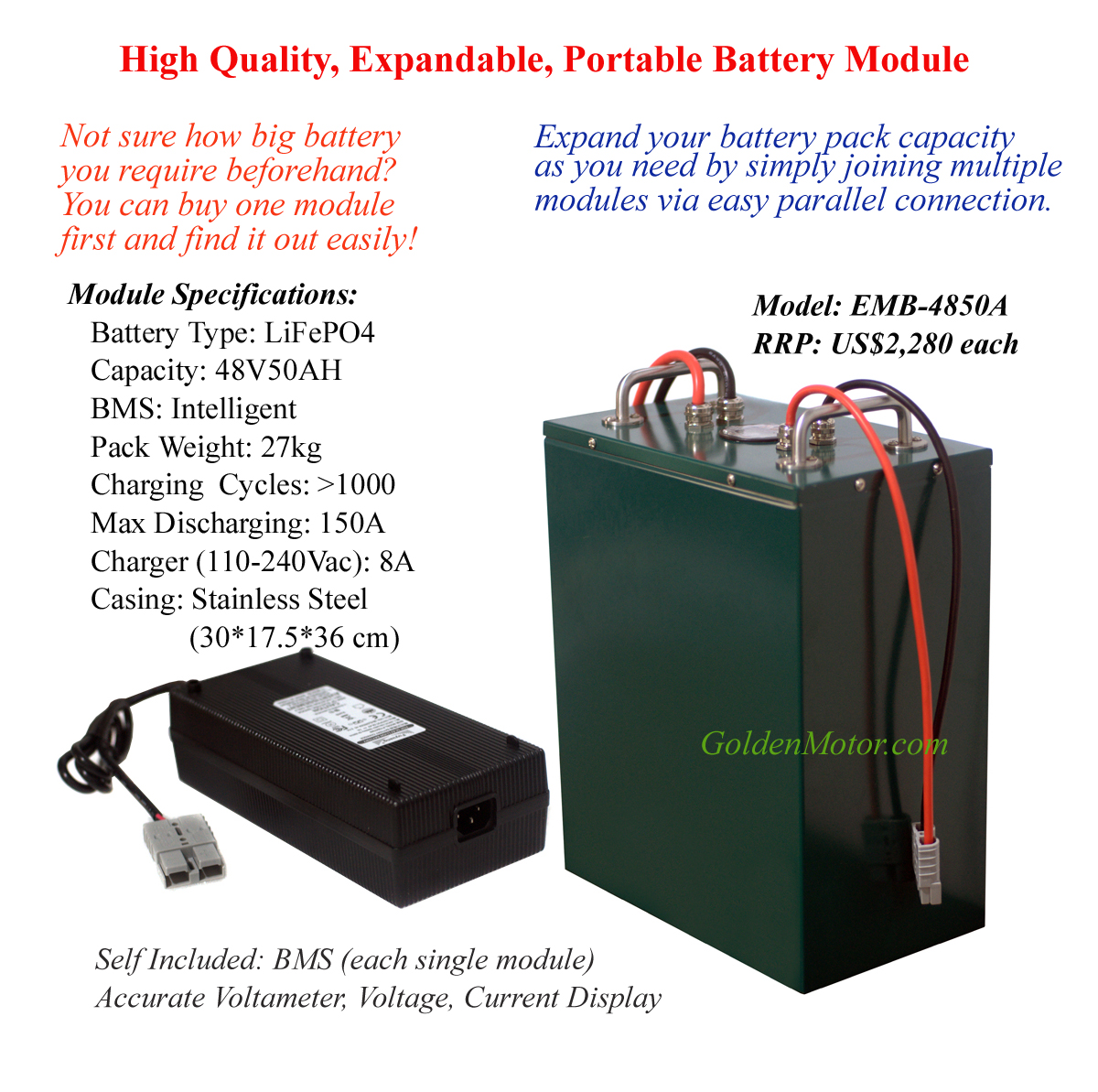
Our expandable battery modules will make your life much easier to determine how big the battery bank you need to meet your purpose. You can just buy one battery module first to test performance and find out accurate amp draw for your special application, then you can easily figure out how many such battery modules required to get the EV speed and travel duration you want. You can easily parallel link up to 4 expandable battery modules to form a larger capacity battery bank by using our Scalable Battery Hub (QuadCell). You can use two such hubs to link up to 8 battery modules. Each battery module is light weight for one person to carry around. Each module has its own battery management system (built-in BMS) and charger. We have developed two models of battery module for diffrent electric boats, 48V30AH and 48V50AH. Their features and functions are basically same except they have different capacities. All have its built-in LED meter.
We choose the most safe LiFePO4 battery type for our expanable battery modules, the materials used inside battery cell will not cause any fire or explosion. The quality of cell is very consistent and can last more than 2000 charging cycles. Its C-rating is 3 times, that means a single 48V50AH module can output 150A continuosly. That's why you can buy just one or two battery modules first, to test the motor performance and get amperage to calculate before you know the exact battery capacity you need.
Lithium Battery Packs for Electric Bikes |
|||||||||
DLP-01 |
|||||||||
 |
|||||||||
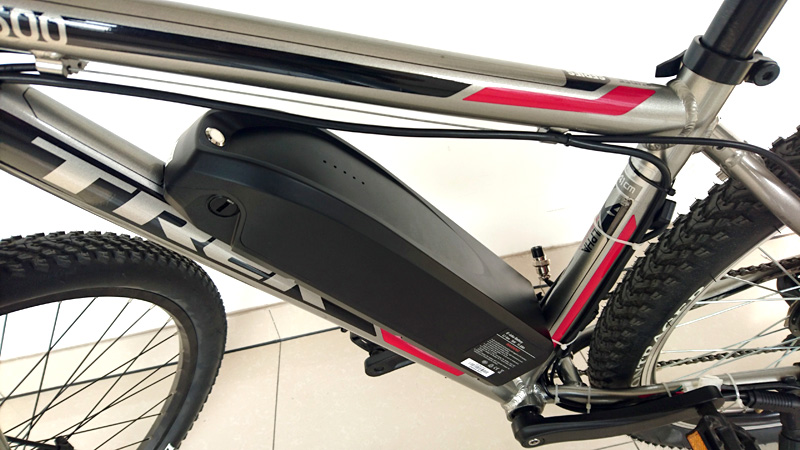 |
Model: DLP-01 (easy installation on common bicycles) Specs: 36V11.6A / 48V11.6A
|
||||||||
36V11.6AH Pack with Charger ($280) |
|
48V11.6AH Pack with Universal Charger ($338) |
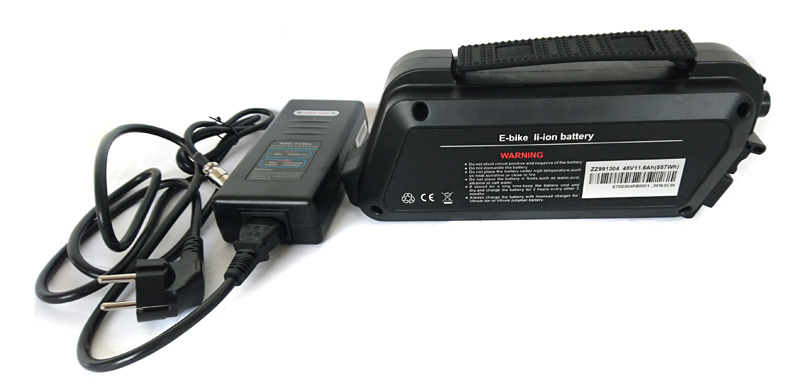
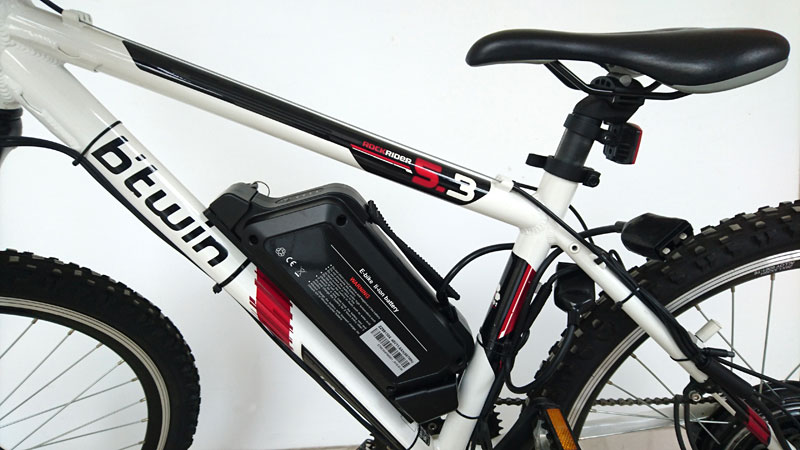
Model: DLP-02 (easy installation on common bicycles)
Specs: 36V11.6A / 48V11.6A
Cell: Panasonic 18650GA 3450mAh
Configuration: 13S4P
Max Discharge Current: 15-25A
Continuous Charge Current: 2-3A
Dimension(L*W*H):340*86*130mm
36V11.6AH Pack with Charger ($290) |
|
48V11.6AH Pack with Universal Charger ($348) |
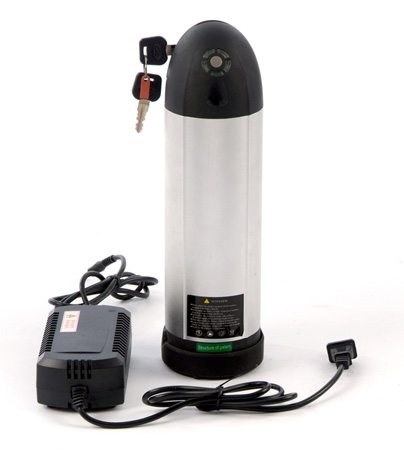
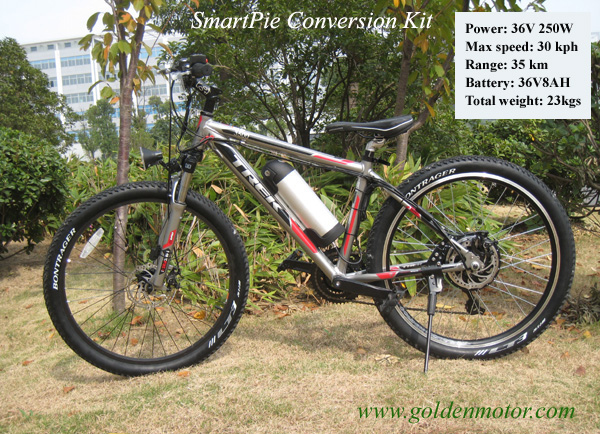
Model: WBB
Very Light and Easy Carry Water Bottle LiMn Battery Packs
36V08AH: 2.5kgs, for 35-40km range per charge
24V10AH: 2.1kgs, for 30km range per charge
24V08AH: 1.8kgs, for 25km range per charge
Come with mounting bracket, keys, and universal charger
WBB-3608M
36V/8AH $215/set |
WBB-2410M
24V/10AH $198/set |
WBB-2408M
24V/8AH $179/set |
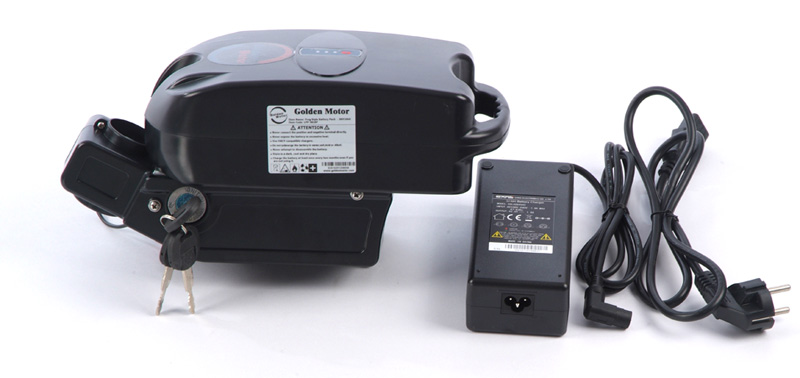
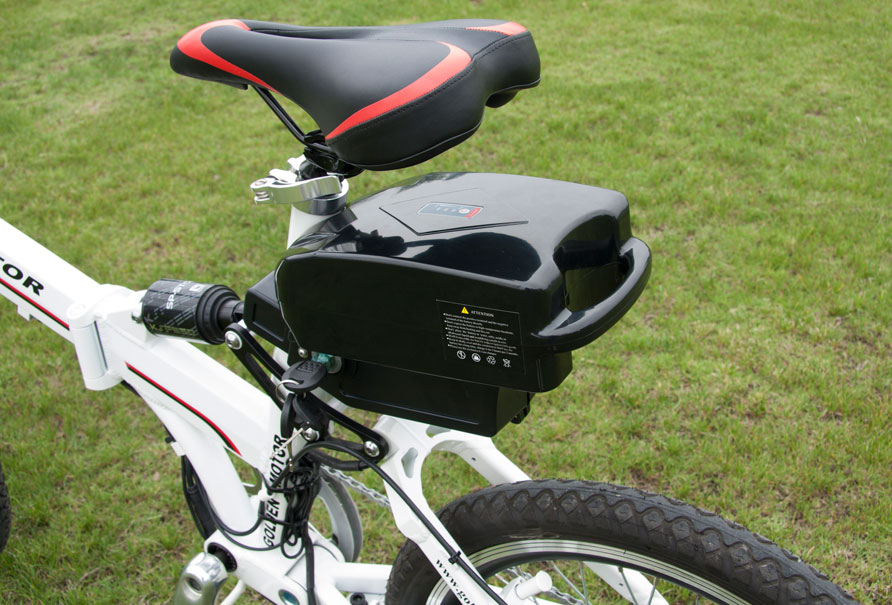
Model: LFP / LBC
Frog Style Battery Pack (LiMn Battery Cells)
-- 24V10AH, or 36V10AH
| LFP-3610F 36V/10AH $269/set |
LFP-2410F 24V/10AH $198/set |
LBC-36U2 Extra Charger $35/set |
LBC-24U2 Extra Charger $35/set |
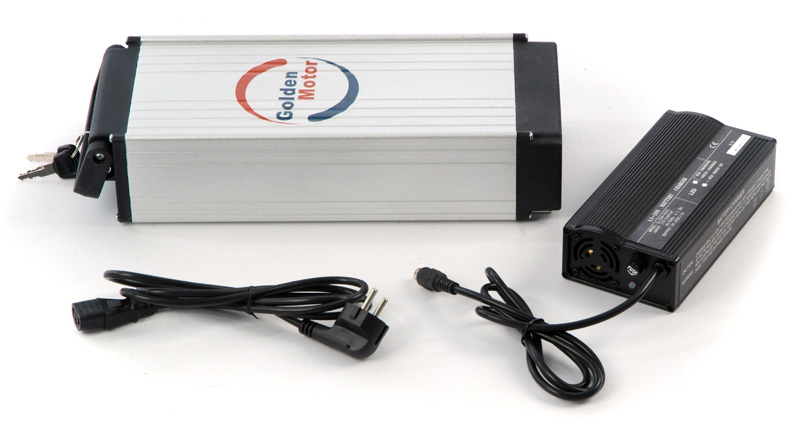
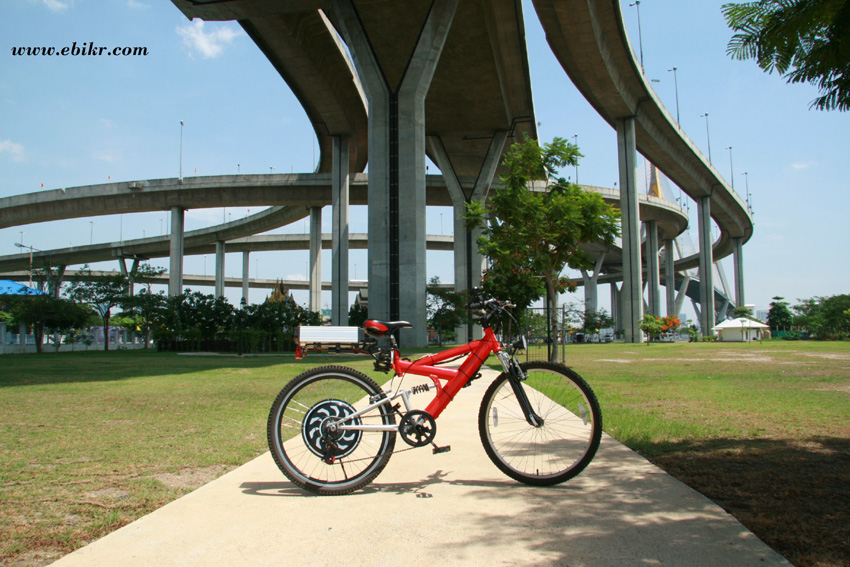
Model: LFP / LBC
Top Quality LiFePO4 Battery Pack for Electric Bikes
-- 24V20AH/36V10AH/36V12AH/48V10AH
Large and safe LiFePO4 cells inside
Compact in size and light in weight (dimensions)
BMS manages to each cell for high reliability
Extra long cycle life - 5 times life of Lead Acid and 2 times of NiMH
Extremely safe: no explosion, no fire under collision, over charged or short circuit
LiFePO4 Battery Pack with BMS/Charger and Optional Sliding Rack
Aluminium Casing with Switch/Key -- FREE!
BMS and 110V-240Vac 2A Universal Charger Included (optional 4A)
Weight: below 5.5Kgs
Capacities: 24V/20AH, 36V/12AH, 36V/10AH, or 48V/10AH
Max Discharge Current: 35A(12AH)/60A(16AH)
Max Continuous Discharge Current: 20A(12AH)/30A(16AH)
Charging Cycles: >1000 times
Ranges(full electric mode): 40Km(36V12AH) or 55Km(48V10AH)
Packing Box Dimensions: 24cm X 24cm X 39cm
LFP-3612S
36V/12AH $316/set |
LFP-4810S
48V/10AH $396/set |
LFP-2420S
24V/20AH $349/set |
LBC-48U3
48V/3A Charger $48/set |
LBC-36U2
36V/2A Charger $35/set |
LBC-24U2
24V/2A Charger $35/set |
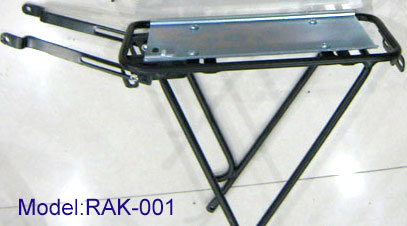
RAK-001
Rear Sliding Rack $29/set |
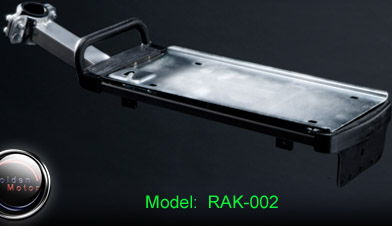
RAK-002
Seat Post Rack $35/set |
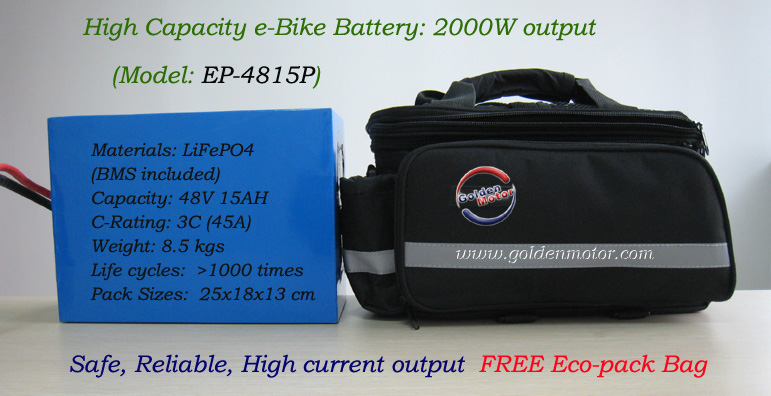
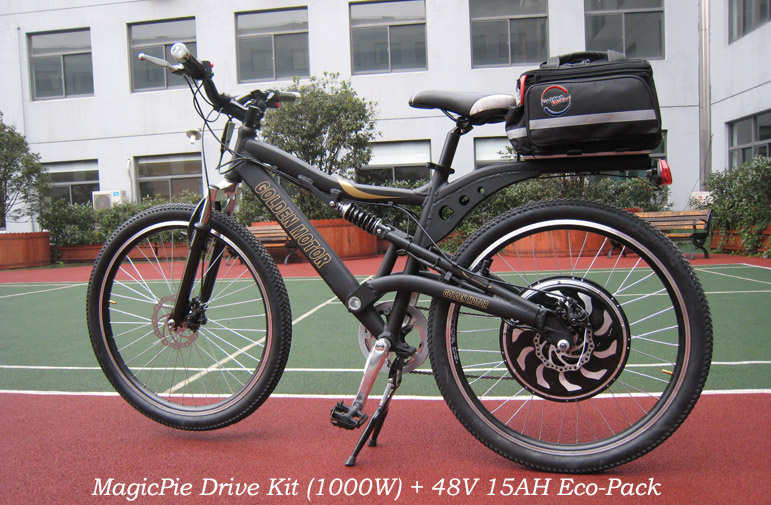
Model: EP-4815P
Safe,Reliable,High current output Free Eco-pack Bag
High Capacity e-Bike Battery: 2000W output
Materials: LiFePO4(BMS included)
Capacity: 48V 15AH
C-Rating: 3C (45A)
Weight: 8.5 kg
Life cycles: >1000 times
Pack Size: 25*18*13 cm
|
EP-4815P
48V/15AH $568/set |
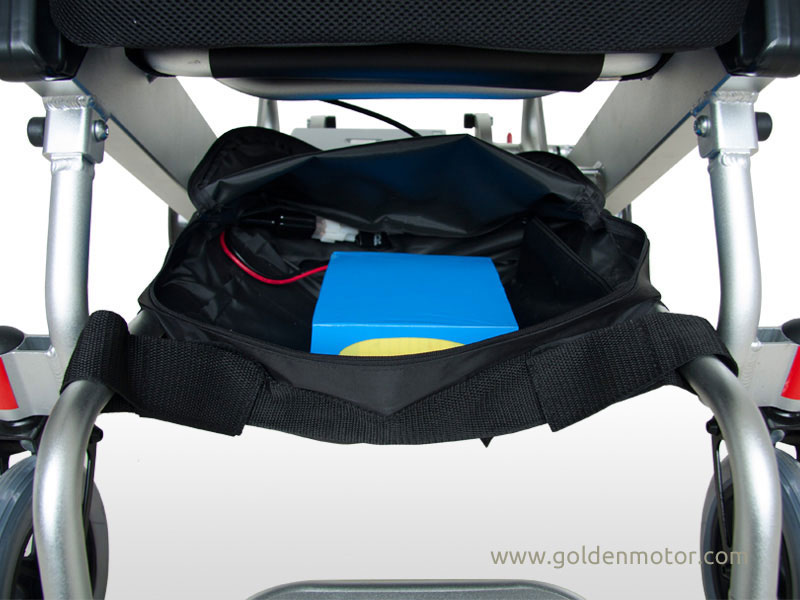
LiFePO4 Battery Pack for Electric Wheelchair |
|
Eco-pack |
|
 |
|
 |
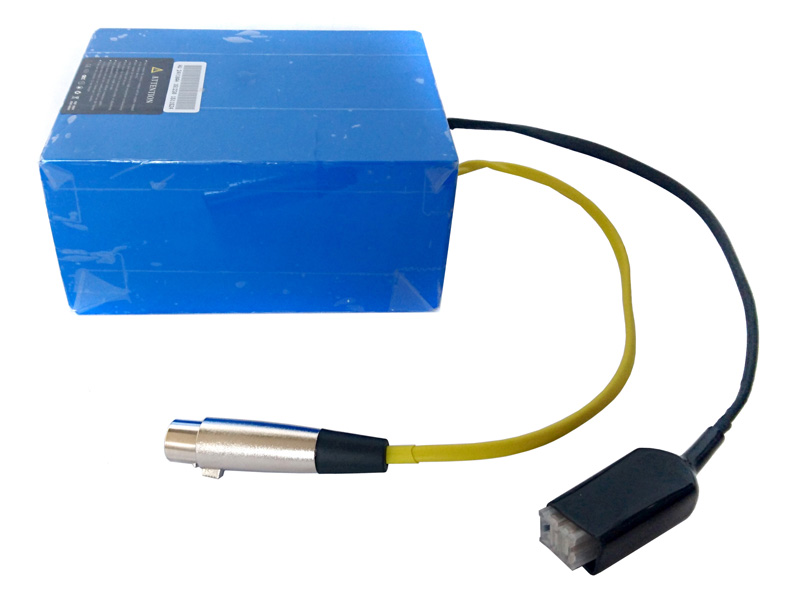
Model: EP-2410F
Buy Now (USD 215.00) |
 |
|
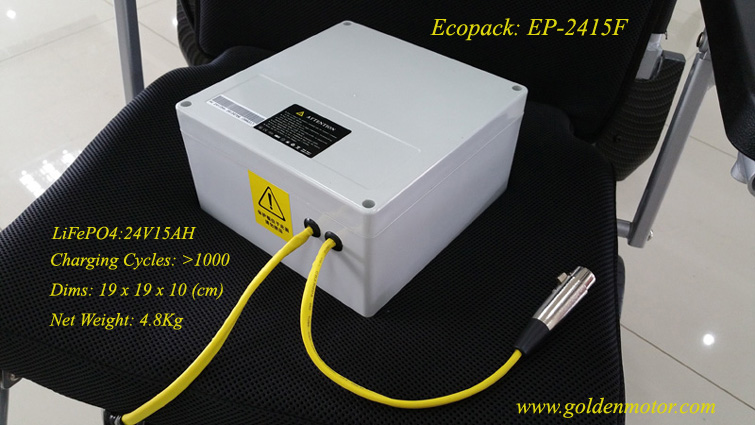 |
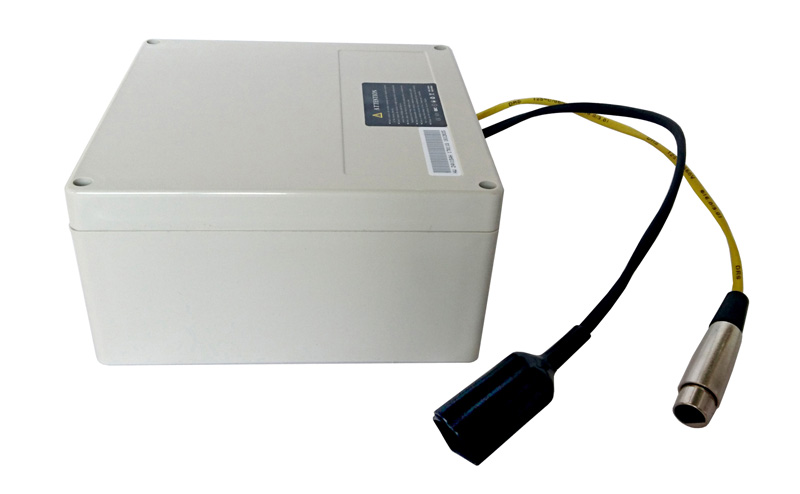
Model: EP-2415F
Buy Now (USD 318.00) |
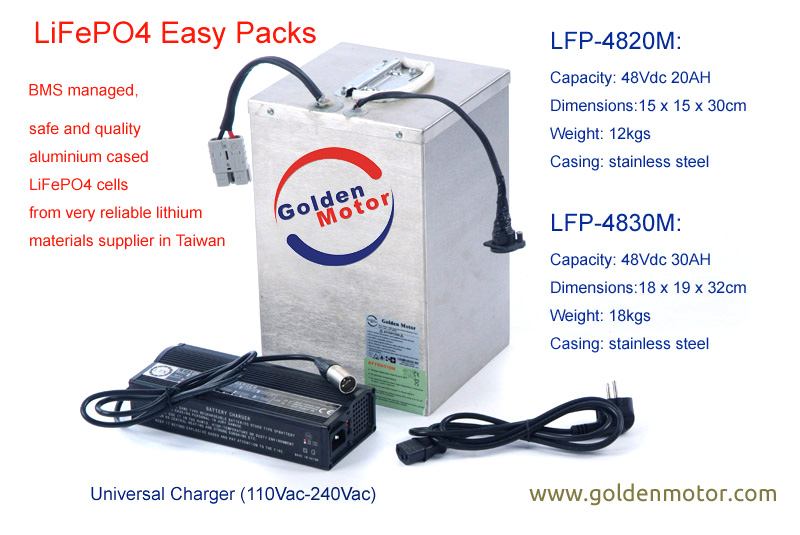
LiFePO4 Battery Pack with BMS and Charger
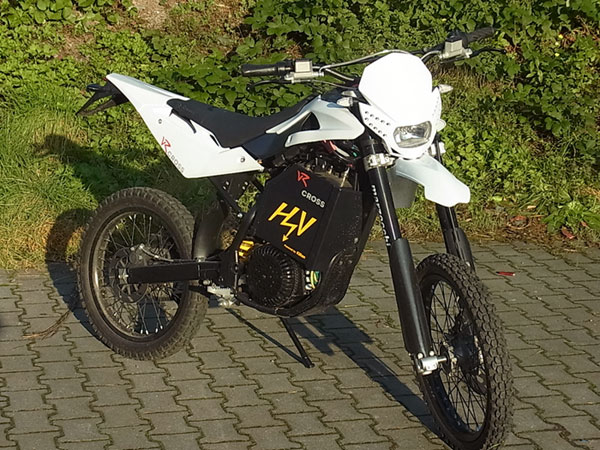
for electric motorcycles, tricycles |
|||||
LFP |
|||||
 |
|||||
 |
Model: LFP4820M |
||||
|
|||||


 via PayPal...
Self-Managed Exandable Battery Module with BMS for EVs |
|
 |
 |
You can easily join expandable battery modules to form larger capacity battery packs |
Portable & Foldable Solar Chargers |
||||||
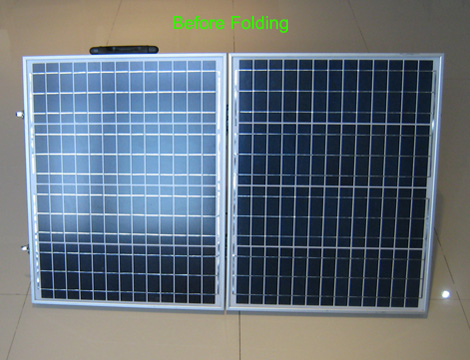 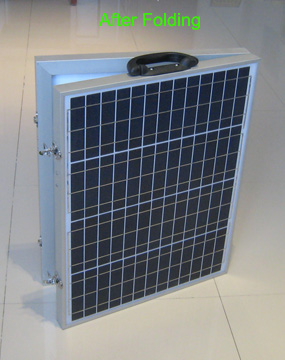 |
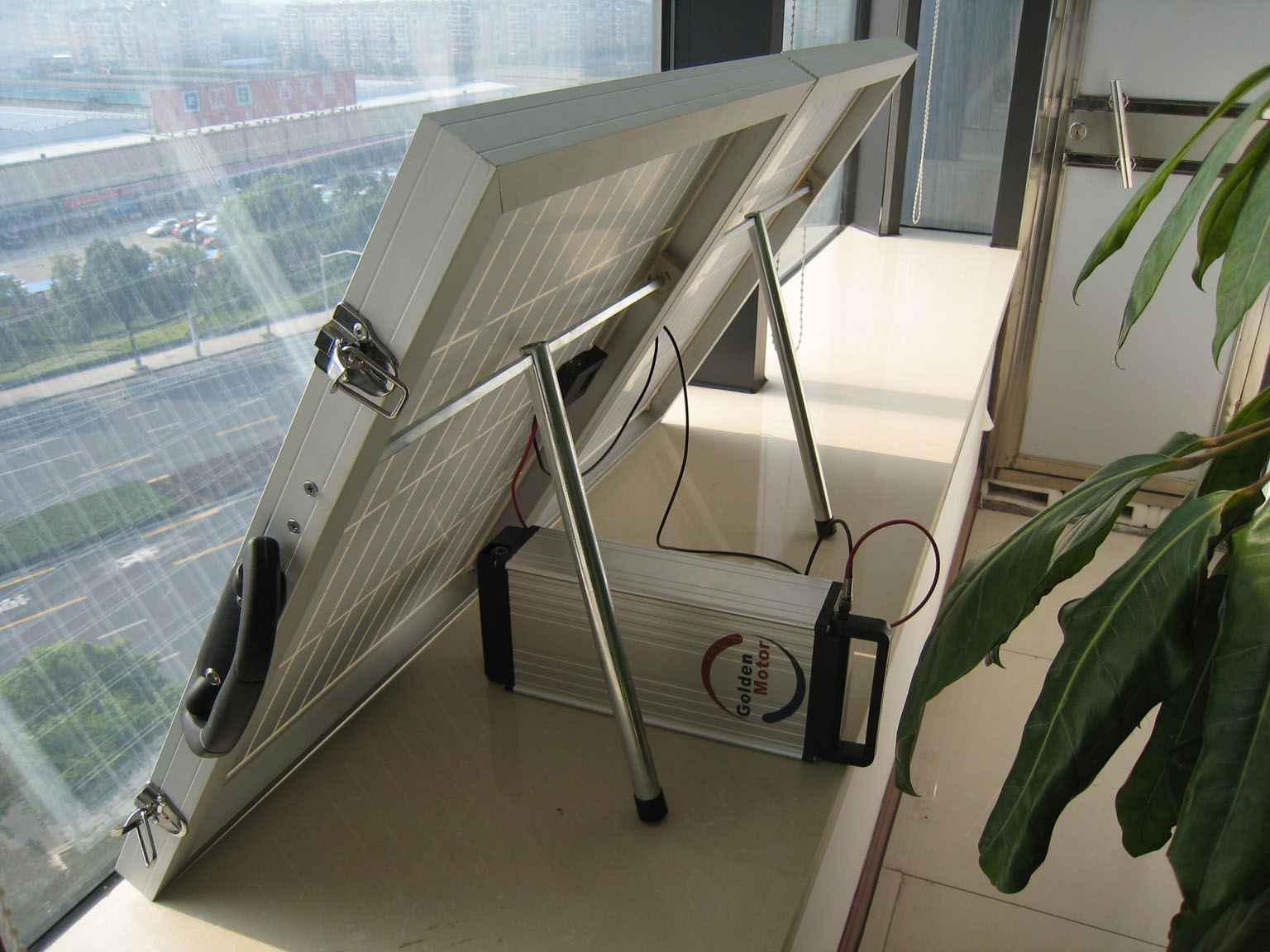 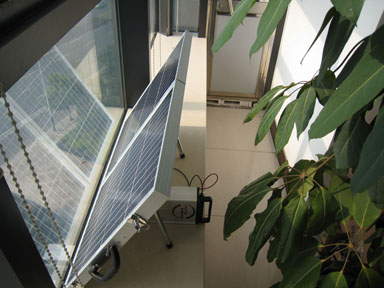 GoldenMotor portable and foldable Solar Charger available in 36V (charing output: 50.8V) and 48V (charging output: 70V). The weight is 12kgs, dimensions: 67*53*8cm after folding. You simply plug and charge your battery pack with sun shine! You can fold the two solar panels and carry it like a suit case, easily place it into your car boot. |
MODEL:SCR-4880 (48V 80W) |
||||
|
||||||
Innovation in Li-ion Battery
LiFePO4Power Battery: Faster charging and safer performance
It is
clear that the small capacity Li-ion (polymer) Battery containing lithium
cobalt oxide (LiCoO2) offers a genuinely
viable option for electronics and digital applications. However, lithium cobalt
oxide (LiCoO2) is very expensive and un-safe for large capacity Li-ion Battery.
Recently lithium iron phosphate (LiFePO4) has been
becoming "best-choice" materials in commercial Li-ion (polymer)
Batteries for large capacity and high power applications, such as lap-top,
power tools, e-wheel chair, e-bike, e-car and e-bus. A
LiFePO4 battery has
hybrid characters: as safe as lead-acid battery and as powerful as lithium ion
cells. The advantages of large format Li-ion
(polymer) batteries containing lithium iron phosphate (LiFePO4) are listed as below:
1. Fast charging:
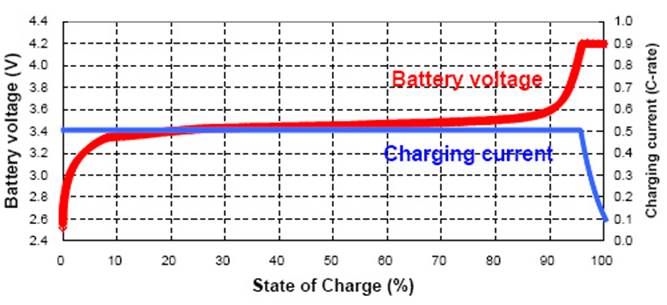
During charging process, a conventional
Li-ion Battery containing lithium cobalt oxide (LiCoO2) needs two steps to be fully charged: step 1 is using constant
current (CC) to get 60% State of Charge (SOC); step 2 takes place when charge
voltage reaches 4.2V, upper limit of charging voltage, turning from CC to
constant voltage (CV) while the charging current is taping down. The step 1
(60%SOC) needs two hours and the step 2 (40%SOC) needs another two hours.
LiFePO4 battery can be charged by only one step of CC to reach 95%SOC or be
charged by CC+CV to get 100%SOC. The total charging time will be two hours.
2. Large overcharge tolerance and safer performance
A LiCoO2 battery
has a very narrow overcharge tolerance, about 0.1V over 4.2V of charging
voltage plateau and upper limit of charge voltage. Continuous charging over
4.3V would either damage the battery performance, such as cycle life, or result
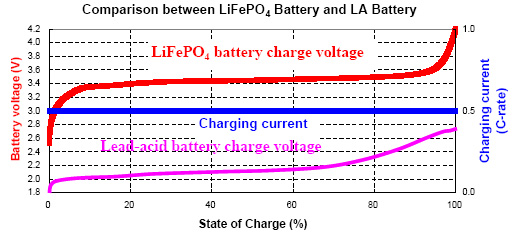
in firing and explosion. A LiFePO4 battery has a much
wider overcharge tolerance of about 0.7V from its charging voltage plateau
3.4V. Exothermic heat of chemical reaction with electrolyte measured by DSC
after overcharge is only 90J/g for LiFePO4 verse
1600J/g for LiCoO2 . The more is the exothermic heat, the larger
energy heating up the battery in its abusive condition, the more chance toward
firing and explosion. A LiFePO4 battery would be
overcharged upto 30V without portection circuit board. It is suitable for large
capacity and high power applications. From viewpoint of large overcharge tolerance
and safety performance, a LiFePO4 battery is similar to
lead-acid battery.
3. Self balance
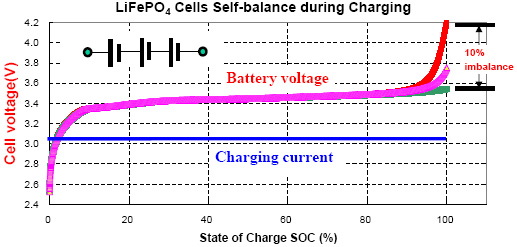
Alike lead-acid battery, a number of LiFePO4 cells in a battery pack in series connection would balance each
other during charging process, due to large overcharge tolerance. This self
balance character can allow 10% difference between cells for both voltage and
capacity inconsistency.
4.
Simplifying battery management system (BMS) and battery charger C-LiFePO4 LiCoO2 LiMn2O4 Li(NiCo)O2 SAFETY AND ENVIRONMENTAL
CONCERN Excellent, Best among all
existing batteries Not stable every
dangerous Acceptable Not stable very
dangerous CYCLE LIFE Excellent Best among all
the listed groups Acceptable Unacceptable Acceptable POWER WEIGHT DENSITY Acceptable Good Acceptable Best LONG TERM COST Excellent Most
economic High Acceptable High WORKING TEMP. Excellent -45C¨C70C
Decayed beyond -20C
¨C 55C Decayed
extremely fast over 50C Decayed
extremely fast over -20C ¨C 55C REMARK 2.
Nickel
Hydride battery has a characteristic of low Power Weight Density, decayed
faster under the high temperature, worse in memory effect, not suitable for
high output usage. 3.
The
C-coated Lithium Iron Phosphate Battery has been proven as the most
environmental friendly battery. It is the safest and most suitable for high
output usage. It is also the best for storage battery usage.
Large
overcharge tolerance and self-balance character of LiFePO4 battery would simplify battery protection and
balance circuit boards, lowering their cost. One step charging process would
allow to use simpler conventional power supplier to
charge LiFePO4 battery instead to use a expensive professional Li-ion battery charger.
5.
Longer cycle life
In comparison with
LiCoO2 battery
which has a cycle life of 400 cycles, LiFePO4 battery extends its cycle life up to 2000
cycles.
6.
High temperature performance
It is detrimental to
have a LiCoO2 battery working at elevated temperature, such as 60C.. However, a LiFePO4 battery runs better at elevated temperature,
offering 10% more capacity, due to higher lithium ionic conductivity.
Comparison data among various Lithium base batteries:
Although,
Lead Acid battery is lower in cost and safety acceptable; however, with
extremely toxic, worse for the environmental concern, short cycle life, heavy
in weight, therefore, we don't put it as a group for comparison.
> TOP <
