goldenmotor.com
September 08, 2010, 12:11:40 PM *
Welcome, Guest. Please login or register.
Did you miss your activation email?

Login with username, password and session length
News: Magic Pie II Dual Drive will be coming out before 2012
 
   Home   Help Search Login Register  
Pages: [1] 2   Go Down
  Print  
Author Topic: What is inside the throttle?  (Read 710 times)
Jazzjerry
Bachelor of Magic
***
Posts: 130


Carpe Noctum


WWW Email
« on: January 24, 2010, 04:14:22 PM »

Ok, So today I tried to take appart the throttle. I wanted to see if I was able to directly draw some wiring from there to my cycle analyst.

Would not trie this as the plastic is not just screwed together but also glued. Putting it back together would require glue and taking it appart is taking the risk of unrepairable damage.

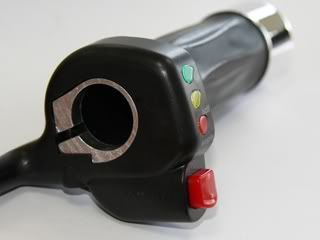
So here is the GM throttle

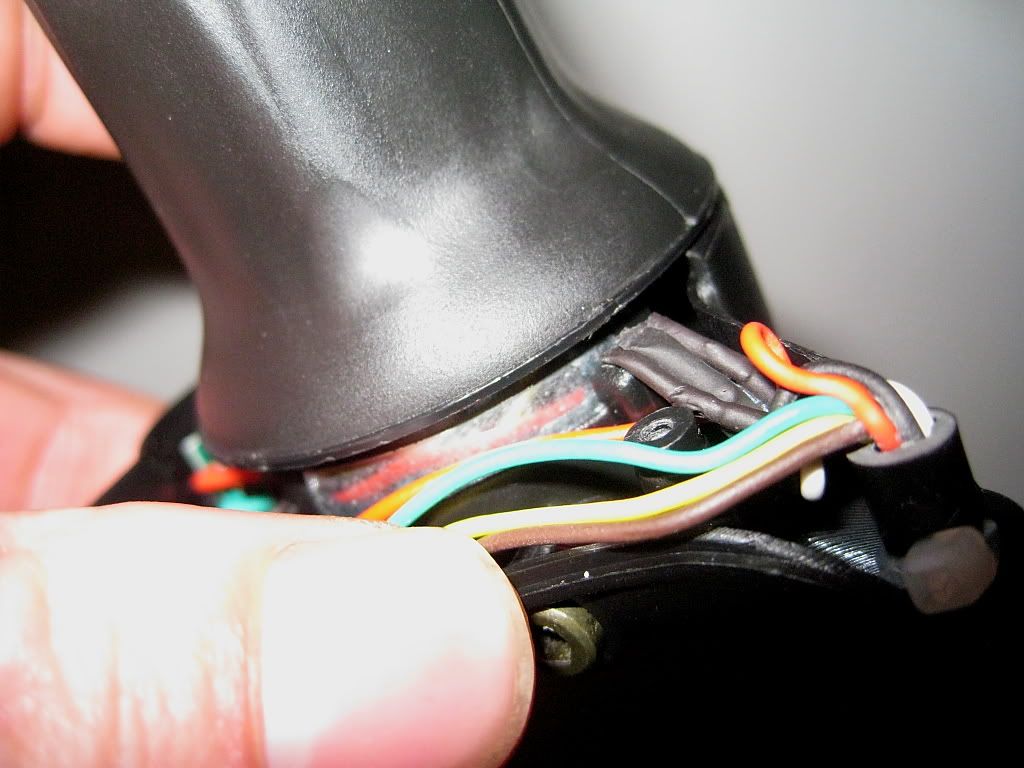
Opened up it looks like this.
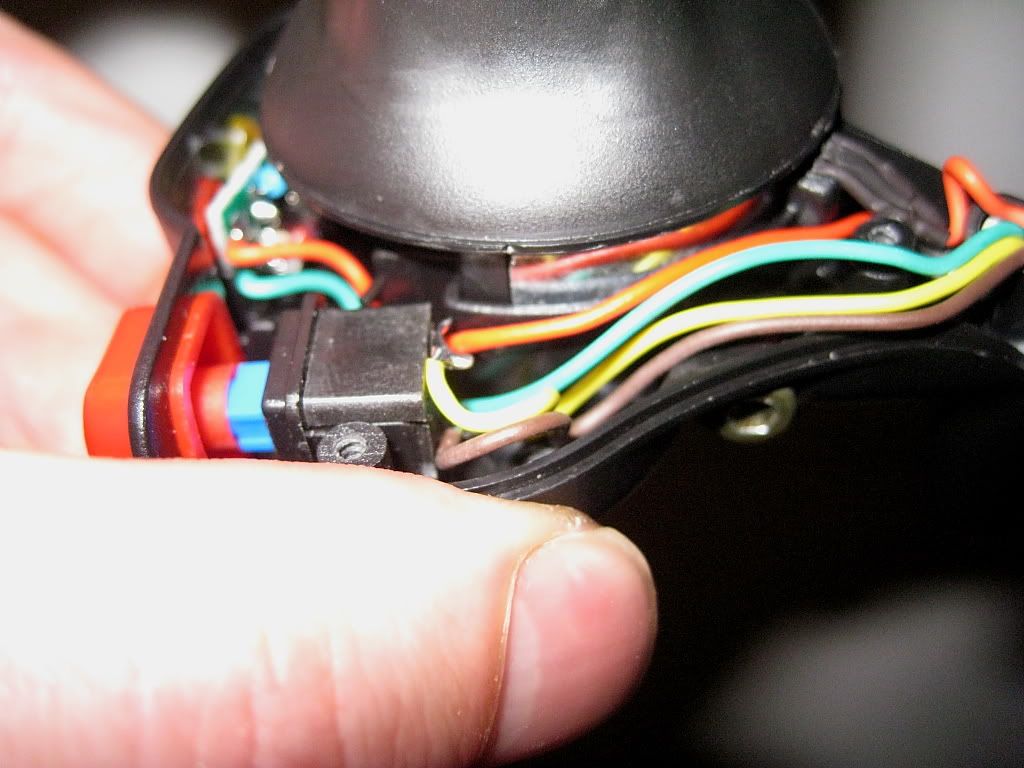

You can see that the brown and yellow wire come together on the red switch.
The green wire goes to the batt lights and must be high voltage....... The red wire going to the batt lights accually is ground. This little red wire is connected to the black coming from the controller.

White red and black however run to a very narrow point.

I first thought this was where the wires were leading even deaper into the housing. After some closer examination I thought the Red Black and white came together here in a connector of some sort.

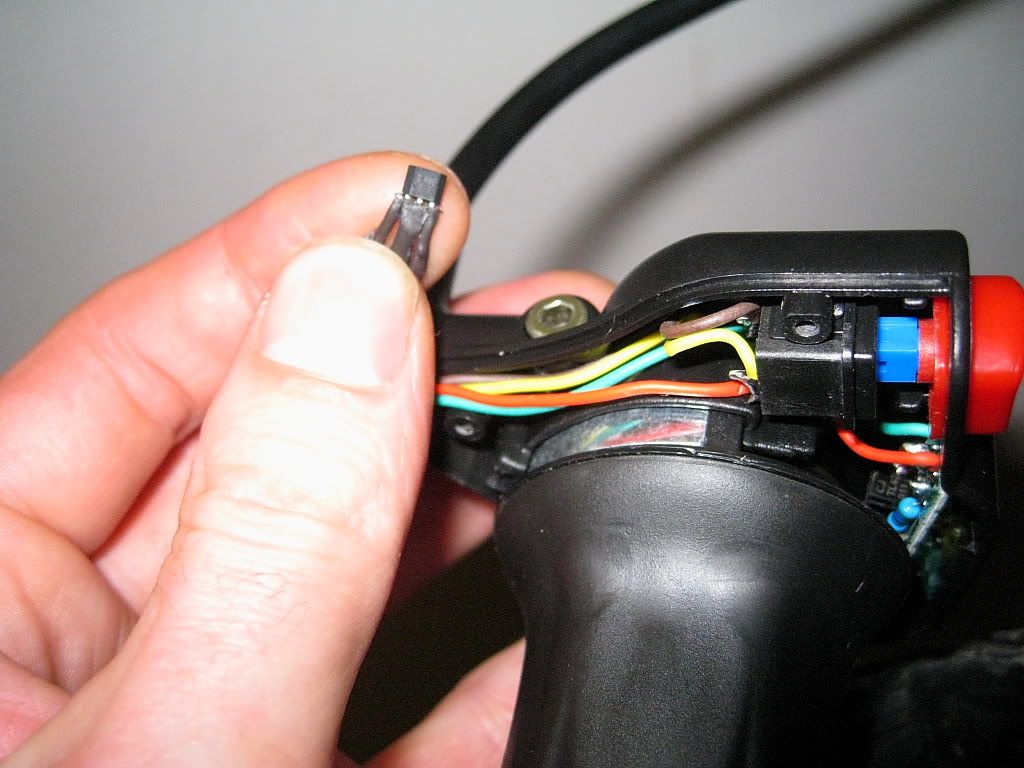
So I did some gentle pulling and wobling and out it came.....  Grin


Examining even closer..... HUH  Tongue

What the....... is this?


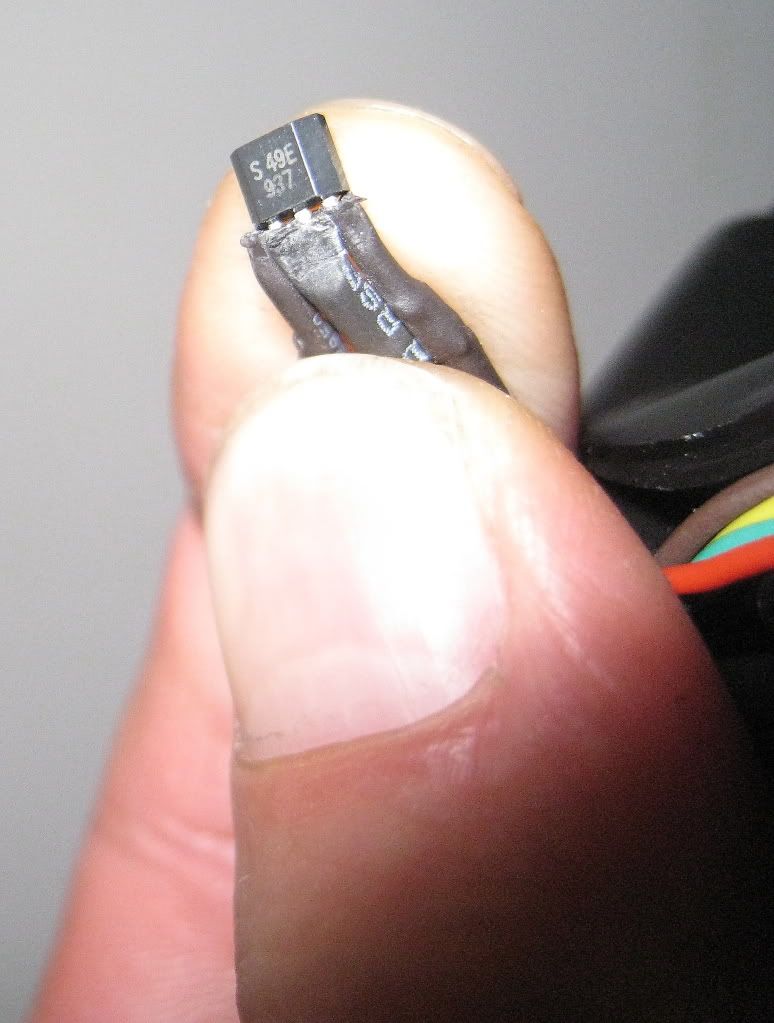
Looks like a sensor of some sort. Could not read the fine print untill I took this macro photo.

Have been googling for this part S 49E 937
but cant seem to find any information.

I also checked what it could be measuring and I have discovered that the mettal ring and moving part of the throttle accualy is magnetised. So How would this work?


Logged

. _   _   __  __  ___  ____  ____  _     _   ____  ____
 ( )_( ) (  ) (  )(  _ \ (  _ \ (  _  )(  \/\/ ) ( ___) (  _ \
  ) _ (   )(__)(  ) _<  )___/ )(_)(  )      (   )__)   )    /
 (_) (_)(_____)(__ / (__)  (____)(__/\__)(____)(_)\_)
Bikemad
Headmaster
PhD. Magic
*****
Posts: 840


gm.moderator@hotmail.co.uk
« Reply #1 on: January 24, 2010, 04:46:19 PM »

What the....... is this?


Looks like a sensor of some sort. Could not read the fine print untill I took this macro photo.

Have been googling for this part S 49E 937
but cant seem to find any information.

I also checked what it could be measuring and I have discovered that the metal ring and moving part of the throttle actually is magnetised. So How would this work?


Jerry, you've discovered the Hall effect sensor, which is used instead of a variable resistor.
Being solid state, there are no moving electrical parts to wear or suffer from poor contacts. This means they are generally more durable and reliable than a conventional variable resistor (potentiometer).

Quote from: Wikipedia
A Hall effect sensor is a transducer that varies its output voltage in response to changes in magnetic field

The three connections are +5V (Red lead), 0V (Black ground lead) and signal out (White lead).

Twisting the throttle simply moves the magnetic field closer to the sensor, which causes a higher signal voltage to be sent to the controller.

Alan
 
« Last Edit: January 24, 2010, 04:55:28 PM by Bikemad » Logged
Jazzjerry
Bachelor of Magic
***
Posts: 130


Carpe Noctum


WWW Email
« Reply #2 on: January 24, 2010, 04:50:54 PM »

So If I would glue a neodynium magnet to someones e-bike throttle, And they would put their ignition key on ..............

 Shocked

their bike would run off......


 Grin lol lol

But I understand now...

Thanks Alan.
Logged

. _   _   __  __  ___  ____  ____  _     _   ____  ____
 ( )_( ) (  ) (  )(  _ \ (  _ \ (  _  )(  \/\/ ) ( ___) (  _ \
  ) _ (   )(__)(  ) _<  )___/ )(_)(  )      (   )__)   )    /
 (_) (_)(_____)(__ / (__)  (____)(__/\__)(____)(_)\_)
hardcore
Master of Magic
****
Posts: 328


« Reply #3 on: January 25, 2010, 01:59:27 AM »

nice i got some neod. magnets, but no other cyclist on e-bikes  Wink
Logged
Jazzjerry
Bachelor of Magic
***
Posts: 130


Carpe Noctum


WWW Email
« Reply #4 on: January 25, 2010, 03:32:21 AM »

We can meet up one day hardcore when my bike is finished..... lol  Cheesy But I would pay xtra attention if you got near my throttle.... lol  Grin
Logged

. _   _   __  __  ___  ____  ____  _     _   ____  ____
 ( )_( ) (  ) (  )(  _ \ (  _ \ (  _  )(  \/\/ ) ( ___) (  _ \
  ) _ (   )(__)(  ) _<  )___/ )(_)(  )      (   )__)   )    /
 (_) (_)(_____)(__ / (__)  (____)(__/\__)(____)(_)\_)
hardcore
Master of Magic
****
Posts: 328


« Reply #5 on: January 28, 2010, 02:09:09 PM »

hey i got a question, how close does the magnet comes to the hall effect sensor, maybe if you can get it nearer to the sensor it will absorb more Amps from the batts and you will go faster or am i not right?
Logged
muzza.au
Bachelor of Magic
***
Posts: 150


« Reply #6 on: January 28, 2010, 04:03:13 PM »

Quote from: hardcore
hey i got a question, how close does the magnet comes to the hall effect sensor, maybe if you can get it nearer to the sensor it will absorb more Amps from the batts and you will go faster or am i not right?
No no no. The magnet in the throttle is a long curved magnet and the sensor just senses the change from the north pole to the south pole as you turn it. I think the sensor is like a transistor, but is affected by magnetic fields.
Quote from: Bikemad/Alan
The three connections are +5V (Red lead), 0V (Black ground lead) and signal out (White lead).
The signal out will then vary between 0-5v as it moves across the magnet field, signalling either 0% throttle up to 100% throttle. It can only be between 0 and 100%, you cant go higher than 100%. The only way to get more current is to modify the controller.

I had a throttle fall apart on me once and then I used it as a test throttle when setting up my other bike and I had it at half throttle when I dropped it and it came apart, but the wheel kept going. I think the sensor only detects changes in magnetic field and as it was at 50% it was halfway between N and S and possibly nuetral magnetic field. Therefore when it came apart it probably moved perpendicular to the field and detected no change and therefore the controller just kept the current speed going.

Muzza.
« Last Edit: January 28, 2010, 08:29:34 PM by muzza.au » Logged

60v 30a tyre burner setup.
Smeee
Guest
« Reply #7 on: January 28, 2010, 10:10:44 PM »

Yes on the north south thing.


I think the first figure is the correct application we use in throttles.


I pulled one of the magnets out of one of these today just to play with.

The magnet seems to lack magnetism in the centre and has a pronounced field N and S polarity on each end of it.

N and S are both with in the same ferris medium allowing some continuity between them and allows for a smooth shift from one polarity to another and relieves the hall sensor direct  continuity from either pole unless fully on or fully off.

One style I looked at was based on the above picture where the package is faces either the N or S.  .


Like the picture above indicates the push pull linear hall effect prefers two separate magnets  

The throttle I pulled apart, the hall package is faced horizontal.

There is so much to consider when repairing these thing as you can skin this cat in a few ways.

« Last Edit: January 28, 2010, 10:14:07 PM by 317537 » Logged
Smeee
Guest
« Reply #8 on: January 28, 2010, 11:33:15 PM »

What the....... is this?


Looks like a sensor of some sort. Could not read the fine print untill I took this macro photo.

Have been googling for this part S 49E 937
but cant seem to find any information.

I also checked what it could be measuring and I have discovered that the metal ring and moving part of the throttle actually is magnetised. So How would this work?


Jerry, you've discovered the Hall effect sensor, which is used instead of a variable resistor.
Being solid state, there are no moving electrical parts to wear or suffer from poor contacts. This means they are generally more durable and reliable than a conventional variable resistor (potentiometer).

Quote from: Wikipedia
A Hall effect sensor is a transducer that varies its output voltage in response to changes in magnetic field

The three connections are +5V (Red lead), 0V (Black ground lead) and signal out (White lead).

Twisting the throttle simply moves the magnetic field closer to the sensor, which causes a higher signal voltage to be sent to the controller.

Alan
 

That part resembles the honeywell ss49e.  Often they Chinese make duplicates of the original part and name them almost the same.

http://sensing.honeywell.com/index.cfm?ci_id=140301&la_id=1&pr_id=128770

In your throttle it is horizontal yet the data sheet states the gauss is vertical from back to the front of the package.

With the answers more questions arise.

I am reading they may require a biase magnet or something but I am failing to find any such thing.

Maybe the effect of N S on the front of the package is enough to alter the resistance.
  
Quote
I think the sensor only detects changes in magnetic field and as it was at 50%

I think they latch the resistance to the last gauss field.

-1000 to 0 gauss = 0v to 2.5v
0 gauss it half throttle.
0 to +1000 gauss = 2.5v to 5v  


Also 0 gauss = half throttle.  no magnet on a powered throttle hall will allow half the input to go to the output

I do think if you were to remove the magnet a powered hall remains at the last state due to N P polarisation of the medium.

Not sure really but from memory I had an incident where the throttle handle came off in my hand it latched.

Remove positive input and no output
Remove the ground input and you get full output.
« Last Edit: January 29, 2010, 12:07:41 AM by 317537 » Logged
Bikemad
Headmaster
PhD. Magic
*****
Posts: 840


gm.moderator@hotmail.co.uk
« Reply #9 on: January 29, 2010, 06:28:28 AM »

Not sure really but from memory I had an incident where the throttle handle came off in my hand it latched.

I seem to recall reading that they are biased to the mid setting and the voltage is either pulled up or down from there.

That would leave you stuck on half throttle if the handle pulls off.

Alan
 
Logged
John-uk
Freshman
*
Posts: 24


Email
« Reply #10 on: February 07, 2010, 06:30:53 PM »

How does the Button throttle work. I fitted The twist grip and have misplaced the button throttle supplied and wondered if there was any easy way to hack in a simple push button into the cuircut ?

Regards John UK

PS. also i would be interested to see if im getting full output/input from my throttle
Logged
Jazzjerry
Bachelor of Magic
***
Posts: 130


Carpe Noctum


WWW Email
« Reply #11 on: February 08, 2010, 01:56:34 PM »

Measuring full in out difference could be done by measuring the 5 v (in) and the throtle signal out with a multimeter. Full open throttle should give the same voltage as source 5v inaproxemetly .

For the rest break it open and have a look..... dont forget to take some photo´s for the curious minds here in the forum.

 Cheesy

JJ
Logged

. _   _   __  __  ___  ____  ____  _     _   ____  ____
 ( )_( ) (  ) (  )(  _ \ (  _ \ (  _  )(  \/\/ ) ( ___) (  _ \
  ) _ (   )(__)(  ) _<  )___/ )(_)(  )      (   )__)   )    /
 (_) (_)(_____)(__ / (__)  (____)(__/\__)(____)(_)\_)
Bikemad
Headmaster
PhD. Magic
*****
Posts: 840


gm.moderator@hotmail.co.uk
« Reply #12 on: February 08, 2010, 08:15:24 PM »

Full open throttle should give the same voltage as source 5v inaproxemetly.

Jerry, just to clarify; maximum throttle should give a signal voltage of approx 3.5V not 5V.

Between Black (Z/0V) and Red (T1/+5V) it should read almost 5 Volts.
Between Black (Z/0V) and White (T2) it should gradually vary between 0.5 and 3.5V (±0.5V) as the throttle is slowly twisted

How does the Button throttle work. I fitted The twist grip and have misplaced the button throttle supplied and wondered if there was any easy way to hack in a simple push button into the circuit ?

John, I think the button throttle you are referring to is actually the cruise control and horn button unit.
The button is used in conjunction with the throttle to set the cruising speed and would not make your motor go any faster.

A simple push button and a 5K resistor could be wired into the throttle circuit to give full throttle, but I'm not really sure it would be worth the hassle, as you already have a better throttle control.

Alan
 
Logged
Jazzjerry
Bachelor of Magic
***
Posts: 130


Carpe Noctum


WWW Email
« Reply #13 on: February 09, 2010, 10:17:24 AM »

Thanks for clearing that up Bikemad.
Logged

. _   _   __  __  ___  ____  ____  _     _   ____  ____
 ( )_( ) (  ) (  )(  _ \ (  _ \ (  _  )(  \/\/ ) ( ___) (  _ \
  ) _ (   )(__)(  ) _<  )___/ )(_)(  )      (   )__)   )    /
 (_) (_)(_____)(__ / (__)  (____)(__/\__)(____)(_)\_)
John-uk
Freshman
*
Posts: 24


Email
« Reply #14 on: February 09, 2010, 02:07:36 PM »

will be taking a looksee shortly. thanks all.
Logged
Pages: [1] 2   Go Up
  Print  
 
Jump to:  

Powered by MySQL Powered by PHP Powered by SMF 1.1.11 | SMF © 2006-2009, Simple Machines LLC Valid XHTML 1.0! Valid CSS!